The Internet TESL
Journal
r.belchamber [at] latrobe.edu.au
La Trobe University Language Centre (Melbourne, Austrailia)
Flags: A Classroom Activity
Rebecca Belchamberr.belchamber [at] latrobe.edu.au
La Trobe University Language Centre (Melbourne, Austrailia)
This is a classroom activity to encourage analytical thinking. Describing flags is an insight into other cultures and also a means of guiding students to organise their thoughts.
Introduction
Have you ever asked your students to describe their flag? Or that of the country they are studying in? There are many benefits in this exercise, which began as a filler on a Monday morning. I wanted to start on some material that would be the foundation for the week's work so needed to wait until the latecomers arrived. To use up some time, I looked to the Australian flag on the wall and asked the class to describe it.What Responses Might You Get?
They might start with the colours -- "It's red white and blue." "There are some stars." "The English flag is in the corner." These are all valid responses, which I noted on the board as the foundation for the next step.Taking It Further
I sketched a map of the U.K. on the board, drew in the various countries, and marked England. Then I indicated that the flag on the Aussie flag belonged to all the countries on my map. I elicited the names of the unmarked countries and then crossed out the word English to replace it with British. At this point I gave the class the term "Union Jack."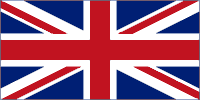
The Union Jack
What about the stars? There are two groups. There is a single, large star and a cluster, which represents the Southern Cross. So, they have described what we see on the flag.
Next, I asked where each item is situated on the flag. This is where students need to organise their thoughts. Which side are they going to start from? Where is the British flag? This is a good way of drawing attention to the word order in phrases like "top right corner." Having established that the Union Jack is "in the top left corner," some students might want to say the Southern Cross is "in the top right corner." But it occupies the whole side, so "on the right" is more accurate. What about the single, large star? Here they can use "in the bottom left corner," or "under the Union Jack. "

The Southern Cross
We dealt with what they see and where they see it. Then we moved on to the significance of each item. Students offered their opinions, from world knowledge or guessing. We played around with phrases to indicate the relationship between the U.K. and Australia. Then I asked them to count the points on the big star. What might that number represent? A cluey student will guess the connection to the number of Australian states. And the Southern Cross? Can they see it in the sky at home? From which countries can it be seen? We discussed Australia's location in the Southern Hemisphere.

The Seven-pointed Star
At this point they had a collection of information, which fits into themes or layers. They had a list of what is seen, where it is situated, and the reason for it being there. The next step is to write a small paragraph, which they can work on in pairs or groups. I gave them the following framework:
The (item) is situated ___. It represents ___.Then they work together to construct a description which includes all the elements covered.
What Did They Learn?
Always a debatable question, but what I intended them to learn is outlined below:- some background to the culture they are sharing, for however short a time.
- the notion of organising their thoughts, which is good training for any speaking or writing activity.
- the ability to elaborate, to flesh something out from a framework.
What You Can Do
Explore some significant signs, college emblems or logos with your students. It will certainly challenge their language skills, and give them some background on their new location. They can then apply the same framework to a presentation of their own flag or other relevant symbols.
The Australian Flag
The Internet TESL Journal, Vol. X, No. 11, November 2004
http://iteslj.org/
http://iteslj.org/Lessons/Belchamber-Flags/