Developing an ESP Course Around Naturally-occurring Videotaped Medical Consultations
Joseph Diasjodias [at] kitasato-u.ac.jp
Kitasato University (Japan)
http://www.kitasato-u.a c.jp/WelcomeMed-E.html
The writer will demonstrate ways he has adapted real-life video and audio taped interactions between patients and health care practitioners for use with ESP medical, nursing and pharmacy students. He will show how the video material makes up only one part of a task-based course that also includes: a web-based research project, participation on mailing lists intended for health care professionals and the making of a video and HyperStudio stack focusing on communication in health care settings.
Introduction
In the course of doctoral studies on doctor/patient interaction in the U.S., England and Japan, the author gathered large quantities of video and audio materials involving physicians and nurse practitioners consulting with patients. The on-going study [the working title of which is "The ambivalent consumer revolution in medicine: ways physicians accept or reject patients as informed co-participants"] makes use of the tools of conversation analysis and ethnomethodology to uncover how 'fuzzy' ideals such as 'client participation', 'patient empowerment', 'user direction' and 'patient-centred health care' are achieved -- or not achieved -- in the unfolding of actual interactions in their naturally occurring contexts.The body of data gathered in this study, and the resulting analyses, provided an opportunity for the development of ESP materials that do not suffer from the problem, typical of many ESL and ESP courses, of being far removed, artificial approximations of the reality they profess to capture. Examples will be given for how large discourse units derived from the taped data can illustrate features of conversation and the consultation process which may not be apparent in the short snippets of dialog commonly used. I will also explain how students themselves can be trained to transcribe naturally occurring data and sharpen their listening skills and sensitivity to contextual clues in the process.
Why Use Real-life Video in ESL/EFL Classes?
The two most compelling reasons for using videos that feature naturally occurring conversation are:- The language is not 'cleaned up'. Hedges, hesitations, false starts, misunderstandings, ungrammatical usages and overlapping speech are preserved so that students get a more accurate picture of how English is used in their areas of specialty.
- Students can do original, meaningful research using the videotaped material as data. The balance of power in medical encounters, for example, can be investigated by having students note, among other things, the number of turns taken and questions asked by the participants. Such investigations would be senseless with commercially produced videotapes, unless the object of study was the depiction of medical consultations as opposed to the consultations themselves.
A Rough Outline of the Course
Who Is This Seminar For?
This seminar is especially intended for students majoring in subjects that will involve contact with patients: nursing, physical therapy, speech therapy, pharmacy, etc. [Those who actually signed up for the seminar, offered to first-year students at Kitasato University, included 9 pharmacy students, 2 students in allied health sciences, 1 nursing student and 1 student of veterinary medicine.]What Will Students Learn?
- ways that doctors and nurses in different cultures (especially England and America) communicate with their patients
- how to transcribe videotapes featuring both naturally occurring and dramatized medical consultations
- how to use the WWW (World Wide Web) to gather information on selected topics
- how to use email comfortably so that students can join and participate in mailing lists for health care professionals and non-professionals interested in sharing information on health issues in which they have a personal stake.
What Resources Will Be Used?
- video and audio tapes recorded by the instructor for research purposes at clinics in America and England
- selections from videotapes of movies and television programs that feature encounters between patients and health care professionals
- HyperStudio -- authoring software for the Macintosh and Windows
- WWW access and email accounts
Course Activities and Examples of Student Work
- Students observe videotaped medical consultations and attend to a variety of features of the interaction. The teacher provides some questions to guide their viewing:
- Watch the whole consultation and make some general observations. What impressions do you have of it?
- How does the consultation begin? Who speaks first and what is said?
- Is a computer used during the consultation? If so, where is it placed in relation to the patient? Can the patient see what is displayed on the monitor?
- Who does most of the talking? Who asks/ answers most of the questions?
- How does the consultation end? Is a follow-up appointment scheduled or discussed? If so, who is the first to mention
Observations will be shared with classmates by means of oral presentations. Written summaries of the presentations made by classmates will be required. [The latter activity insures that the audience will listen attentively. As they are each given a different consultation to study, students are sure to give unique presentations that will be of interest to others in the class.]
Excerpt from a student's summary of a classmate's presentation: Mayuko saw a consultation between a male doctor in his 40s and a female patient in her 30s. There is a computer between them and both can see the screen. The patient has a headache and she thinks it's caused by stress at work. The doctor takes her blood pressure but there is no problem. The treatment is medication. The patient has been doing some exercise and the doctor agrees with her that exercise is important. The relationship is mutual participation. In the end, they finish the consultation with the doctor's words: "Good luck."
- Groups of three students will work together to search for (and organize) information about selected clinics in the U.S., Japan and Britain which are represented on the WWW. Oral presentations should emphasize the respective attitudes of the clinics' staff toward the health care provider/patient relationship. Differences or similarities in attitudes toward the patient/ health care provider relationship in the three countries should be noted.
Excerpt from a student's summary of a classmate's presentation: Megumi looked at the home page of Yokohama Kousei Byouin. She chose to look especially at the palliative centre. There are doctors, nurses and paramedics. They have three mottos: community of information, formation of mutual agreement among doctors, and the idea that the medical group is not omnipotent.
- Transcription skills (see Psathas, 1995: pp. 70-78) will be taught so that students can produce accurate transcripts of videos, thereby making it possible to make comparisons of the features of different clips.
- Again in groups of three, students will get together and select one to two-minute excerpts from 3 videotapes to transcribe. The videos will include: one with naturally occurring consultations, another from an episode of the television program ER and a third from a video produced by Britain's National Health Service on communication in health care settings (NHS Training Directorate, 1991). An oral dramatization of the transcriptions will be performed for the class and transcripts must be turned in along with an analysis of common or contrasting features.
Excerpt from a group's transcription of one of the consultations videotaped by the instructor:
[Female doctor in her 30s consulting with a teenage boy who has a cold]
- Doctor: Right. What's your problem?
- Patient: Umm (.) I was feverish and not so well (3.0) last night and
- Doctor: You sound a bit (coldy) =
- Patient: = I =
- Doctor: = yeah
- Patient: Yes then I ( ) as usual ((cough)) I've just been coughing all day. Well, ( ) get off ( ) so far might be long =
- Doctor: = yeah
- Patient: and (..) well
- Doctor: You been ( ) (fe---) rushing looks like it =
- Patient: = and I almost feel like really really hot and really really (torrid)
- The next activity involves the use of mailing lists either for health care professionals or for patient support. Students were given the following directions:
Mailing List Participation & Presentation
- Step 1: Use Netscape to find the following location on the WWW -- http://www.liszt.com . The Liszt Web site features a catalog of most of the public mailing (discussion) lists. Search the catalog for mailing lists related to health or health care.
- Step 2: Select two mailing lists that are of interest to you. One of them must be intended for health care providers and another should be for patient self-help (or for the support of family members of people with medical conditions). For example, you can join a list for nurses who are discussing professional concerns and another list for family members of people suffering from eating disorders.
- Step 3: Spend a week or so just monitoring the messages that are sent to you by the mailing list. Take notes about the sorts of topics and issues participants are discussing.
- Step 4: Answer the following questions about the mailing lists ... [Note: You'll only be able to answer some of them after you've been on the list for a week or two.]
- For whom is the list intended?
- What are the 'rules' for participation on the list? [These are usually sent to you in a 'welcome message' after you have successfully subscribed to (i.e., joined) the list.]
- What sorts of topics or issues are participants discussing?
- Approximately, how many messages are sent to the list each week?
- Are just a few people dominating the 'discussion' or is the exchange carried out by many different people?
- Is there any controversy? Do people disagree or appear to be arguing with each other?
- Do you think the discussion on the list is interesting? Why or why not? Give some examples.
- As you read the messages, what impressions do you get about the way patients interact/communicate with health care professionals in the countries represented on the lists?
- Is this a useful (constructive) list? Why or why not?
- Step 5: After you have monitored the mailing lists for a week or two try sending a message to each of the lists. In your message you can explain who you are and make a comment (or ask a question) about one of the issues brought up by other participants.
- Step 6: Answer the following questions about your contribution to the mailing list ...
- How did you contribute to the list? What sort of message did you send?
- Did anyone respond? If so, what did he/she/they say?
- Was your participation in the mailing list a positive or negative experience? Why?
- Step 7: Compile a portfolio that includes a) examples of messages sent to the mailing lists, including your contributions and responses to those contributions; b) your detailed answers to the questions listed above.
- Step 8: Follow the instructions in the lists' "welcome message" to unsubscribe from the lists. Of course, if you want to continue to receive messages you can delay carrying out this step.
A particularly fine exchange on a mailing list called OUR-KIDS, between one of the pharmacy students and a teacher from Minnesota, is reproduced below:
From: Kazue
Subject: Some questions to you
------------------------------
Hello everyone. I am a Japanese university student . I'm a pharmaceutical student very interested in this list. Today I want to ask you some questions. The fact is I have mild asthma. When I was a child my symptoms were more serious and I had coughed and wheezed so I often had to go to a clinic and they gave me some medication. I wanted to cure my illness so I toughed up my body doing Japanese Kendou, joining a track and field club and chorus club. Now I am 19 years old and my symptoms have become more mild.Do you (or your children) do something to treat the disease without medication? I'm looking forward to your reply.
One of the responses Kazue received:
From: Jane
Subject: Re: Some questions to you
------------------------------
Hello, Kazue. I have 3 family members with asthma (I am one ... ) My oldest son was very sick as a child, with frequent trips to the hospital when his daily regiment of medications would not hold him. We used allergy shots for 11 years to build tolerances and also had him engage in aerobic exercise -- swimming and soccer (he's a great midfielder). At age 16, his lung capacity is above normal. I believe most of it is due to his exercise program and good nutrition. Good luck with your asthma!Based on Kazue's class presentation of her experiences on the mailing list, a classmate submitted a summary that included the following ...
One of the lists Kazue joined is 'OUR-KIDS'. It is for patients, their family, and professionals. As a rule, technical terms must not be used for it may label children. 450 messages are sent every week. Through this mailing list, patients talk about their experiences, encourage each other and ask others for advice. (written by a vet medicine student)
- As a final project students can choose between either making a HyperStudio Stack that sums up and illustrates what they learned about communication during the course of the year or cooperate with classmates to produce a video that demonstrates and analyzes successful and troubled interactions between patients and health care providers.
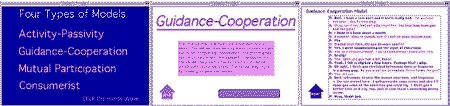
The diagrams below show three screen views of a student-produced HyperStudio Stack that illustrates four models of patient/ health care provider interaction. By clicking on "Guidance-cooperation" in the first screen, for example, one is taken to the screen in the second figure. By clicking on the "Typical Conversation" button on that screen one is taken to the student-conceived dialog in figure 3.
Students' Reception and Reaction to the Videotapes and Activities
Besides difficulties arising from the volume of work and the need to acquire new skills, such as conducting Internet searches, taking notes in English and surviving on NS mailing lists, students felt particularly challenged by the task of trying to understand and transcribe the naturally occurring videotaped consultations. None of the students gave up in despair, not even those with limited English proficiency. This was probably due to several factors: they were allowed to choose the parts of the videotapes they felt able to transcribe; less proficient students could work in groups with those of higher ability; the videotapes could be viewed repeatedly in a self-study AV lab; and the video-related activities all revolved around issues that would be relevant to the health care careers of the students, hence, they were a highly motivating resource.
Bibliography
- NHS Training Directorate. Communicating with Patients: Health PICKUP Programme. Videotape (with accompanying documentation). Intek Europe, Product code 982203, 1991.
- Psathas, G. (1995). Conversation Analysis: The Study of Talk-in-Interaction. Thousand Oaks: Sage Publications.