The Internet TESL
Journal
Purdue University Calumet (Hammond, Indiana, USA)
zimmerman [at] calumet.purdue.edu
Teaching Abstract Concepts in the EFL Classroom
Lynn W. ZimmermanPurdue University Calumet (Hammond, Indiana, USA)
zimmerman [at] calumet.purdue.edu
Abstract concepts can be interesting and challenging discussion topics for students in EFL classrooms.
Introduction
Several summers I have taught English in a three-week summer camp for Polish high school students who come from all over Poland to improve their spoken English skills with native speakers. One of the challenges of teaching in such a camp is that students want to have fun, and not have dull, repetitive lessons. I successfully used an abstract concept, freedom, to intellectually challenge the students while giving them an opportunity to practice their spoken English at an appropriate skill level.Framing the Concept
Abstract concepts can be difficult to discuss effectively without preparation and structure. Since I was teaching in Poland, I decided to call on Polish history to help me frame a discussion about "freedom." However, I have found that students often speak more readily about topics which directly concern themselves and their families. Therefore, the structure of this lesson incorporated their personal and family experiences in the context of Polish history of the last 60 years. The students related family stories told to them by their grandparents about World War II, and by their parents about life under communism. A class discussion about freedom related these stories to their own experiences in post-communist Poland. Finally, groups of students created pictorial representations of freedom which they presented to the class.Outline of the Lesson
- Age Level: high school and up
- English Level: low-intermediate and up
- Time Allowed: minimum 45 minutes
- Materials: paper (to make a banner); colored markers and pencils
1. Pair work -- Sharing stories
- In pairs, tell a story that your grandparents told about World War II.
- A few students share their stories with the class.
- Switch pairs and tell a story that your parents told about life in Poland before 1989.
- A few students share their stories with the class.
2. Whole Class Discussion
- How are your grandparents and parents experiences similar or different?
- How are their experiences similar to or different from your own?
3. Freedom Discussion
Brainstorm -- what does freedom mean?- Relating to the stories you told, what do you think freedom meant to your grandparents? your parents?
- What does freedom mean to you?
- Freedom to…
- Freedom from…
- Talk about the value of freedom -- what would you exchange freedom for? Is freedom worth material possessions? Is freedom worth your life? Is freedom worth the life of another person?
4. Representation of Freedom
- In groups of four, create a visual representation, using words and pictures, of what your group thinks freedom is.
- Present this to the class.
How I Implemented the Lesson
Most of the students in camp were born in the late 1980s, so to lay the groundwork, I asked them if their grandparents had related stories about their lives in Poland during World War II. The students then talked in pairs to tell a story that a grandparent had shared about World War II. A few students shared their stories with the entire class, providing a wide range of stories.- One girl told how her grandmother had continued her education while in hiding during the war. The priest would go from house to house teaching small groups of children away from the eyes and ears of German troops.
- Another told how her grandmother, a teenager, threw a Molotov cocktail at a German tank.
- One boy's grandfather was sent to a forced labor in camp in Germany.
- One boy told about his father's arrest for smuggling goods into Poland.
- Several students told stories of shortages their parents suffered during this time and about the tickets they had to have in order to buy almost everything, from washing machines to beef.
- First, we compared the experiences of their grandparents and parents. The main similarity was that both groups experienced a lack of freedom and of material goods. The students, on the other hand, do not experience these shortages and restrictions. They have more freedom to do things and make choices about their lives than their parents and grandparents did.
- From this, we tried to define freedom, brainstorming terms and aspects of freedom.
- I then emphasized the distinction between "freedom to..." and "freedom from..." and we discussed these concepts in the context of their lives and the lives of their grandparents and parents, whose concept of freedom was based more on "freedom from...", such as freedom from oppression, hunger, etc.
- We continued the discussion talking about the value of freedom: what would you exchange freedom for? Is freedom worth material possessions, your life, the life of another? Most of the students agreed that freedom was not worth anything material. Some of them did assert that freedom was worth their own lives, that they would die for freedom. However, most of them did not believe that their freedom was worth the lives of their loved ones. They would sacrifice their freedom for the life of a loved one. Several commented that while living in freedom was preferable, it is possible to exist without freedom because your captor cannot control your mind and thoughts.
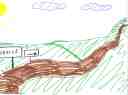
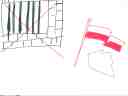
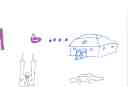
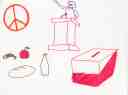
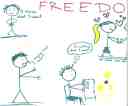
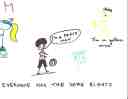
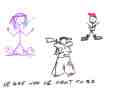
- Finally, in groups of four, the students created a pictorial representation of freedom which they presented to the class. Each group had colored markers and pencils and four sheets of fanfold paper to create banners portraying how they perceived freedom. Primarily, their pictures presented their generation's notion that freedom is "freedom to…" (Figure 1).
Discussing Abstract Concepts in the EFL Classroom
Freedom is one of many abstract concepts that can be an interesting and challenging discussion topic for students in the EFL classroom. With careful planning, such an abstract concept can be framed in such a way that students can use concrete examples from their own lives and experiences to explore their thoughts and feelings about freedom.To find an abstract concept which is relevant in the lived experiences of your students, research the history of their country for the past 50 years. This time frame is the richest because this is the period about which they have most likely heard family stories. Depending on where you are, the abstract concept which is relevant to your students may be peace/war; poverty; religion; or, even, the destruction/preservation of the environment. The discussion will be limited only by the level of your students' English skills.
Figure 1: Click to see larger images.



The Internet TESL Journal, Vol. XI, No. 2, February 2005
http://iteslj.org/
http://iteslj.org/Lessons/Zimmerman-AbstractConcepts