Improving Science Students' Fluency through Project Work
nebila.dhieb [at] fsb.rnu.tn
Science Faculty of Bizerte, Tunisia
Introduction
In recent years, L1 and L2 classroom-based research has shown the effect of interest and involvement in the task in motivating students for communicating in the language. Project work is one example of tasks that provide contexts where the learner might feel a genuine need for using the language.In this article, I shall present guidelines for designing project work in an ESP/EST context, the overall objective being to develop students' communicative oral proficiency.
Literature and Background
Literature
There is now empirical evidence that Content-Based Instruction (CBI) in general and project work more specifically help in setting up contexts where learners are required to respond actively and engage in "purposeful communication" (Candlin, 1987). There are several reasons for this.- Unlike traditional approaches to foreign language teaching which tend to focus on accuracy by teaching discrete grammatical points and vocabulary items, this type of work allows both teacher and student to concentrate on the communicative use of language and content rather than form.
- Learners learn better when they work on the same topic for some time than when they have reading or writing materials on a different topic every time. It is argued that in recycling their knowledge by reading from different sources on the same subject, they develop a sense of self-confidence in the project work (Bereiter and Scardamalia, 1993) and go deeper in the processing of the materials (Anderson, 1990)
- Project work, as this article will show, can be tied up to real-life preoccupations as well as to the range of academic tasks students will encounter in their future academic and professional life. And therefore might enhance students' interests and motivation and provides them with hands-on experience.
Background
The subjects are fourth year biology students at a science faculty. They can be characterised as of intermediate level. They have done four years of general English at high school and one year at the university. The overall volume of time allocated to English is three hours a week for 26 weeks, but only one hour and a half for a period of 13 weeks is devoted to project work. Following the traditions of this scientific institution, the main subjects as well as English have a timetable divided into lectures and T.D.s (i.e. Travaux diriges, which means practice work)As far as English is concerned, previous experiences for this type of session included the presentation of exposes. This presented some advantages (it was something new, students enjoyed it, learned from it) but also some disadvantages.
First, expose were prepared outside class time. Students at this level had a heavy timetable, so definitely they did not invest that much time in it, and the result is that they started looking for shortcuts: translating information given in their main courses, copying information from reference books and encyclopaedia.
Also no genuine discussions were engendered. As this exercise was marked, students thought that asking questions might put their colleagues at a disadvantage so the rule seemed to be "I keep quiet in your expose, so keep quiet in mine!"
The last but not least important point is that students' presentation of exposes became a form of read-aloud information rather than a ground for discussing topics of interest.
New Context
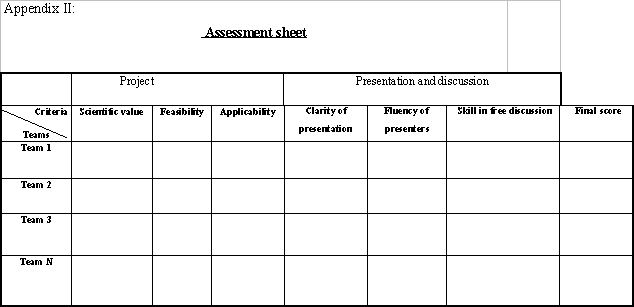
The objective of project work as previously stated is to create a setting where learners feel the need - and actually do- take part in discussion. This came in the form of an advertisement in the faculty's scientific magazine:- "A competition for the best project for research on a biology subject of the year is being organised. On D-day a special committee will meet to consider all proposals for research and will select the best one in terms of its scientific value (what is its contribution to science in general?) , Feasibility (is it feasible in Tunisia?) and applicability (how applicable is it at local, national and international levels?) "
Tasks
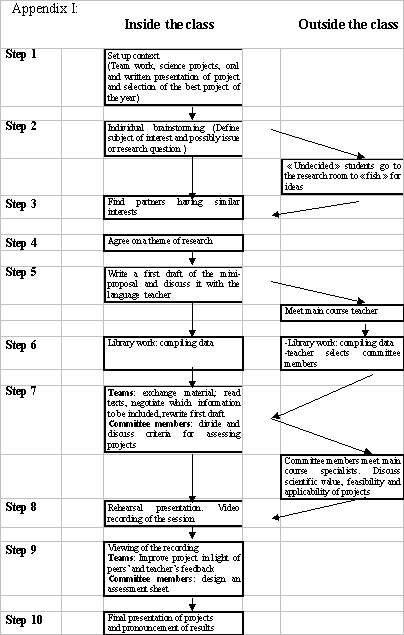
Before the Final Presentation
- Thinking
- Exchanging ideas
- Negotiating
- Writing
- Correcting
- Debriefing: in mid-term, we organised a first recording to familiarise students' with the camera. Students viewed this videotaped playback of the formal oral presentations. They commented on their own and each others' both verbal and non-verbal performance giving the possibility of self and peer correction
- Consulting specialists
- Rewriting
- Rehearsing for final presentation
On the Final Presentation Day
- Groups
- Presenting orally
- Intervening: asking for clarification, asking questions
- Defending (their own subject) and attacking (the others)
- Committee Members
- Open presentation session
- Present groups, members and subjects
- Organise schedule for presentations
- Check the time for each presentation (ask presenters to wrap up, remind them of time left...)
- Manage general discussion at the end of the presentations
- Close presentations and discussion
Evaluation
Positive points
This kind of work raised students' awareness to mistakes, especially after viewing the first recording, They noted the frequent coining of ungrammatical words: such as sensibilate* inhibitate* and transformate* while trying to express themselves.Breakdowns in communication and attempts to repair that by switching to Arabic or French were also noted and English equivalents were proposed. This type of work was also a good opportunity for students to become aware of differences in style between the oral and the written mode.
Besides raising students' awareness of these different aspects of language use, we also recorded the positive reaction of main course specialists. They gave their full backing and support for the groups whose projects fell within the scope of their discipline (gave reading materials, explained difficult points, and suggested useful ideas)
The best outcome was at the level of motivation. This kind of task provided the students with the required framework to work and learn with a sense of purpose. Students read articles, summarised texts, jotted down ideas (in groups) and re-wrote them in a better style, corrected each others' spelling and pronunciation mistakes. Besides the four traditional basic skills (reading, writing, speaking and listening), students practised a variety of study skills (e.g. searching in the library for information.)
Project work develops students' autonomy in learning. They work at their own pace and at the same time feel comfortable and secure in the team as they choose their partners themselves. They also develop a sense of ownership towards the project as they see it gradually take shape.
Negative Points
Some students used languages other than English for in-group discussions. Also, there were students who did not contribute to the group's effort, yet wanted to benefit from the mark given to the group.Conclusion
It is now widely agreed that Communicative Language Teaching can be highly constrained by the absence of real settings, real roles and real needs for communication (see Leng Hui, 1997 for an extensive list of factors that constrain CLT). This is especially true of cultures, which still stick to the view of teachers as "knowledge holders."This kind of work might give the impression that the teacher is sitting back and the students are doing all the work. Actually a lot of work must be done by the teacher both inside and outside of the classroom. Apart from correcting first drafts (each group had at least three) and advising on problems pertaining to language, the teacher has to organise meetings between groups and their respective main course teachers and prepare handouts.
On the whole, spreading this type of activity over a term was, in my view, very successful. Set within an ESP context, this idea of research projects in science, fulfilled the required objective of giving the learners a situation for genuine oral interaction.
References:
- Anderson, J. (1990). Cognitive psychology and its implications. New York: W. H. Freeman.
- Bereiter, C., and M. Scardamalia. (1993) Surpassing ourselves: an inquiry into the nature and implications of expertise. Chicago: Open Court Press.
- Haines, S. (1989). Projects for the ELF classroom: Resource material for teachers. Walton-on-Thames Surrey, UK: Nelson.
- Henry, J. (1994). Teaching through projects. London: Kogan Page Limited
- Leng, H (1997). New bottles, old wine: Communicative Language Teaching in China. English Teaching Forum. Vol. 35/4:38-40.
- Stoller, F.L. (1997). Project work: a means to promote language content. English Teaching Forum. Vol. 35/4:
Appendix I
Appendix II